
Harem
2025
Exposition personnelle
Grand Hall, MACAM – Museu de Arte Contemporânea Armando Martins, Lisbonne, Portugal
Commissaire Adelaide Ginga
HAREM: A TERRITORY OF MEMORY AND RESISTANCE
Harem is an artistic installation that occupies the threshold between the sacred and the forbidden, the visible and the hidden. Consisting of two works – L’amour n’est pas un crime and Azetta #1 – this installation evokes memory and resistance, and is situated on a delicate border between tradition and subversion. Using everyday Moroccan materials, Marion Mounic interweaves memory, narrative and gesture, questioning the harem as a site of confinement and power, desire and prohibition.
A space of female seclusion, the harem conveys a notion of territory that is both sacred and forbidden, a gynaecium inaccessible to men and non-Muslims (except for princes and sultans). The harem is not just a female enclave, but a place where hierarchy meets intimacy, where silence echoes as powerfully as the whispers of unseen negotiations.
It is a territory where the laws of flesh and spirit intertwine in licit and illicit relationships, a space where gender intersects in many directions and is sometimes reversed, as in the case of eunuchs.
A theatre of shadows and light, of domination and resistance, where prohibition and duty pulsate under the veil of tradition. Here, desire knows freedom, just as restriction knows transgression.
L’amour n’est pas un crime
Situated at the heart of the installation Harem, L’amour n’est pas un crime is a monumental canvas painting (nine by three metres) saturated with henna and other organic components, bearing the inscription in Arabic for: “Love is not a crime”. This phrase is a cry of defiance by women in their struggle for rights and new freedoms.
Marion Mounic works in a performative manner, layering gestures on the skin of the canvas in a process of total release – until the accumulation reaches saturation, creating an earthy surface where the scent of henna lingers. The work rises up against the wall like a manifesto, its inscription of resistance subtly emerging from the apparent monochrome and dragging the many shades of love into an echo that reverberates throughout the room. This phrase was used by Moroccan women in protests to demand their rights and to fight for new freedoms, and later appropriated by the LGBTQIA+ community.
Marion Mounic evokes the history of women, their spaces and their resistance, drawing on personal experiences, particularly her family memories and her time in Morocco during artistic residencies. She leads us into an immediate encounter with otherness – between revelation and disappearance, much like the ongoing work of memory itself.
Azetta #1
On the opposite wall, Azetta #1 weaves silences and stories into a woollen frame. In the Berber language, azetta means both ‘loom’ and ‘honeycomb’. Berber women refer to the henna-painted sections of their rugs as aglif n’tizwa, meaning ‘hive’ or ‘swarm’.
Inspired by North African textile traditions, this work extends reflections on spaces of femininity and resistance, moving tapestry from a domestic craft into a political and poetic territory. In the repetitive dance of women’s hands, the memory of a people is woven – each knot holding an echo of resistance, each thread a remnant of voice. Like bees, Berber women build their worlds in silence.
At the loom, they weave a territory of inherited gestures, where henna-dyed threads inscribe a subtle code of existence into the wool.
Like a beehive, the tapestry is a living, collective and pulsating space. In the ochre of the henna-aglif n’tizwa, the painted hive, the unspeakable is recorded, that which can only be felt.
Standing in front of Azetta #1 we are invited to listen to the murmur of these threads. Here the loom ceases to be a domestic gesture and becomes a statement. The wool, displaced from its usual context, occupies the space like a body that resists, narrates and challenges. Stories unfold in its textures, braided with time, silence and strength.
Azetta #1 evokes not only the art of weaving, but also the interconnectedness of identity, memory and transmission. In this work, Marion Mounic appropriates the language of textiles as a sensitive archive, where threads become traces of forgotten voices.
The raw white wool absorbs the henna, forming a filled circle with a surrounding border – transforming everyday materiality into an act of silent resistance.
Here, tapestry is a non-verbal form of writing, woven as an ancestral echo, where every knot and texture pulsates with the ritualised repetition of female gestures – gestures that nurture, that build, but which also assert and fortify. Like a palimpsest, Azetta #1 is a territory of memory and subversion, simultaneously revealing and concealing, evoking notions of belonging and exclusion, visibility and erasure.
In the delicate glow of this immersive installation, infused with olfactory and visual synaesthesia, Marion Monic constructs a space of evocation and defiance, steeped in histories and taboos, and where gender wavers, sexuality resists, and love endures.
Harem offers the audience a sensory experience of otherness, oscillating between presence and absence, between the materiality of objects and the intangible nature of emotions; where the ephemeral is inscribed as a trace, and the forbidden is unravelled in silence.
Between everyday gestures and invisible rituals, the artist gives form to the memories that persist, reimagining spaces of femininity as places of resistance and reinvention.
Harem is murmur, breath, and inscription. In its textures and in the interlacing of the tangible and the absent, it opens a portal where tradition and transgression coexist, revealing that art, like memory, is a continuous act of creation and insurgency.
Texte en anglais pour l’exposition personnelle Harem de Adelaide Ginga, commissaire, MACAM, Lisbonne, Portugal
Interview de Marion Mounic, à l’occasion de l’exposition personnelle Harem, 2025, MACAM, Lisbonne, Portugal, vidéo Francisco Quera-Gomes, MACAM, Lisbonne, Portugal

Vue du montage de l’exposition personnelle Harem, 2025, Grand Hall, MACAM – Museu de Arte Contemporânea Armando Martins, Lisbonne, Portugal, photo Francisco Quera-Gomes

Vue du montage de l’exposition personnelle Harem, 2025, Grand Hall, MACAM – Museu de Arte Contemporânea Armando Martins, Lisbonne, Portugal, photo Francisco Quera-Gomes

Vue du montage de l’exposition personnelle Harem, 2025, Grand Hall, MACAM – Museu de Arte Contemporânea Armando Martins, Lisbonne, Portugal, photo Francisco Quera-Gomes

Vue du montage de l’exposition personnelle Harem, 2025, Grand Hall, MACAM – Museu de Arte Contemporânea Armando Martins, Lisbonne, Portugal, photo Francisco Quera-Gomes

Vue du montage de l’exposition personnelle Harem, 2025, Grand Hall, MACAM – Museu de Arte Contemporânea Armando Martins, Lisbonne, Portugal, photo Francisco Quera-Gomes

Vue du montage de l’exposition personnelle Harem, 2025, Grand Hall, MACAM – Museu de Arte Contemporânea Armando Martins, Lisbonne, Portugal, photo Francisco Quera-Gomes

Vue du montage de l’exposition personnelle Harem, 2025, Grand Hall, MACAM – Museu de Arte Contemporânea Armando Martins, Lisbonne, Portugal, photo Francisco Quera-Gomes
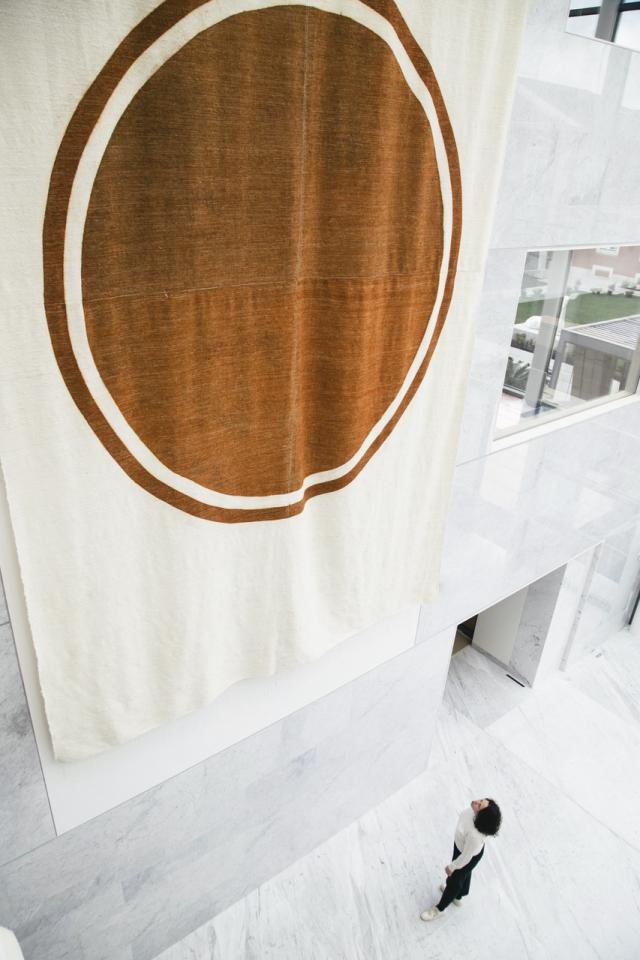
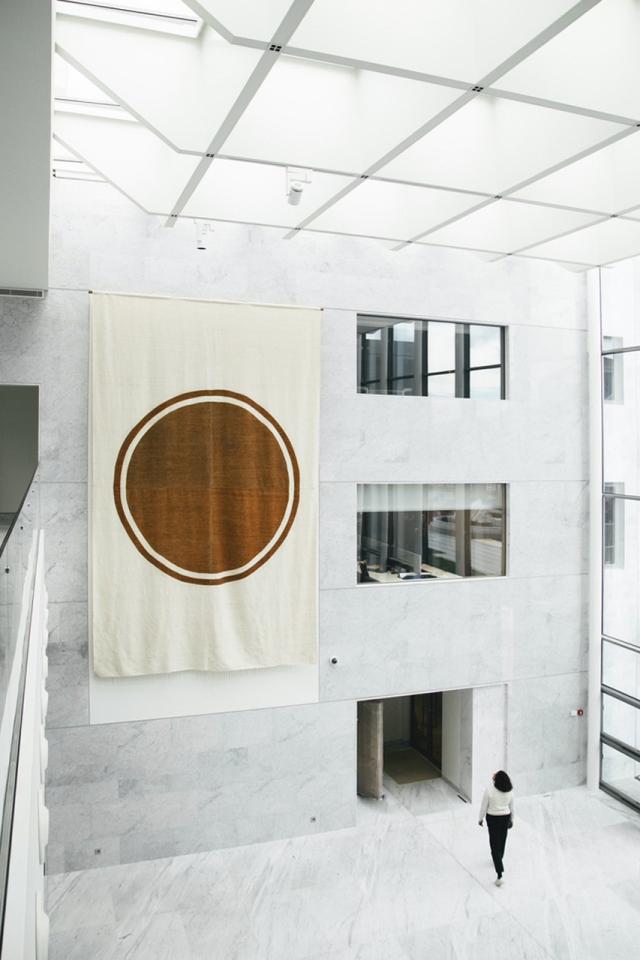

Azetta #1, 2025, installation, laine tissée et henné, 650 x 352 cm, vue de l’exposition personnelle Harem, 2025, Grand Hall, MACAM – Museu de Arte Contemporânea Armando Martins, Lisbonne, Portugal, photo Francisco Quera-Gomes

Azetta #1, 2025, installation, laine tissée et henné, 650 x 352 cm, vue de l’exposition personnelle Harem, 2025, Grand Hall, MACAM – Museu de Arte Contemporânea Armando Martins, Lisbonne, Portugal, photo Francisco Quera-Gomes
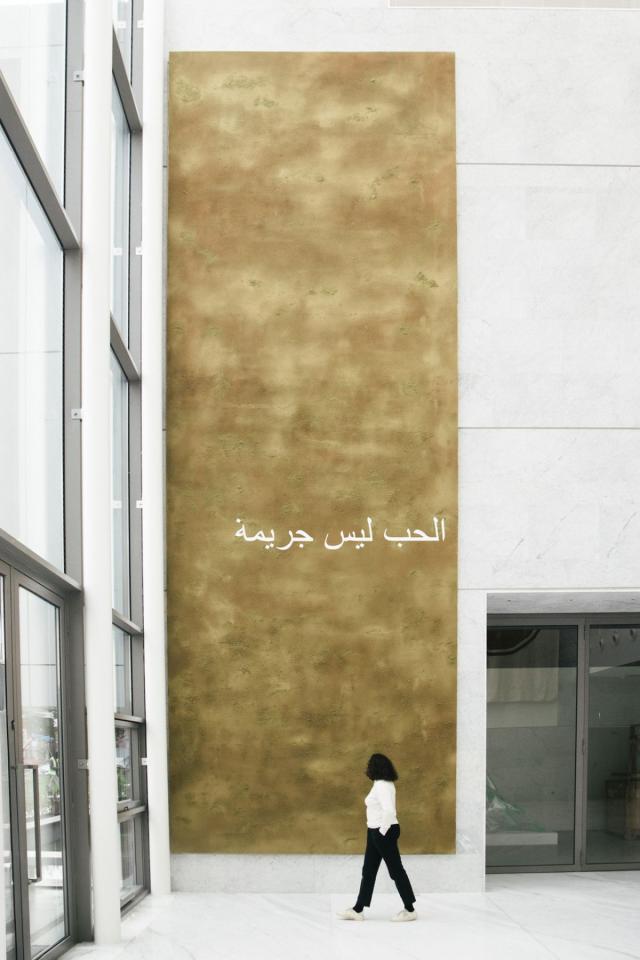
L’amour n’est pas un crime, 2025, installation in situ, henné sur toile, 900 x 350 cm, vue de l’exposition personnelle Harem, 2025, Grand Hall, MACAM – Museu de Arte Contemporânea Armando Martins, Lisbonne, Portugal, photo Francisco Quera-Gomes

L’amour n’est pas un crime, 2025, installation in situ, henné sur toile, 900 x 350 cm, vue de l’exposition personnelle Harem, 2025, Grand Hall, MACAM – Museu de Arte Contemporânea Armando Martins, Lisbonne, Portugal, photo Francisco Quera-Gomes

L’amour n’est pas un crime, 2025, installation in situ, henné sur toile, 900 x 350 cm, vue de l’exposition personnelle Harem, 2025, Grand Hall, MACAM – Museu de Arte Contemporânea Armando Martins, Lisbonne, Portugal, détail, photo Francisco Quera-Gomes

L’amour n’est pas un crime, 2025, installation in situ, henné sur toile, 900 x 350 cm, vue de l’exposition personnelle Harem, 2025, Grand Hall, MACAM – Museu de Arte Contemporânea Armando Martins, Lisbonne, Portugal, détail, photo Francisco Quera-Gomes
Azetta #1, 2025, installation, laine tissée et henné, 650 x 352 cm, vues de l’exposition personnelle Harem, 2025, Grand Hall, MACAM – Museu de Arte Contemporânea Armando Martins, Lisbonne, Portugal, photo Francisco Quera-Gomes